Masto Control is inventory, recipes and production tracking for people who make things in small batches: candles, soap, cosmetics, food, jewellery. Track materials by batch and expiry, know what every piece really costs, and stop rebuilding the same spreadsheet every season.
One product, one supplier, one price: a spreadsheet is genuinely the right tool. It stops being the right tool at a specific and recognisable point.
The wax price goes up. Now twenty products cost something different, and you have to find and edit every one of them. Most people just don't, and quietly sell at last year's margins.
Two deliveries of the same oil, different prices, different expiry. A spreadsheet cell holds one number. It cannot tell you which batch you are actually using, or which one is about to turn.
A market stall, your own shop, an Etsy listing. Different packaging, different commission, and one average price that hides which of them is actually paying you.
Everything below is on every plan. No modules to buy, no per-material limits.
Wax and fragrance bought by the kilo, dosed by the gram and millilitre, spread across dozens of scents. The cost of a candle moves every time a wax delivery arrives at a new price, and with one material in twenty recipes that is twenty costs changing at once. Try your own numbers in the candle pricing calculator.
Actives and preservatives with expiry dates that must not be exceeded, formulations that get adjusted, and small percentages of expensive ingredients where a costing error hides easily. Batch tracking is not paperwork here, it is the point.
Short shelf lives, batch numbers you may need to trace back, and packaging that is itself a material you can run out of mid-run. Oldest batch first is not an accounting preference when the ingredient has a date on it.
Many small components per finished piece, findings bought in bulk and used in ones and twos. Individually too fiddly to cost by hand; collectively the difference between a healthy margin and an imaginary one.
Material bought by the metre or the hide and used in offcuts, where waste is real and worth putting into the recipe rather than pretending it away.
Sheet material and fittings in metres and pieces, with production runs that should reserve stock before the work starts so two orders cannot promise themselves the same board.
Worth knowing before you spend an afternoon on it rather than after.
Labour is costed by time: you set what an hour of a job is worth, put the minutes on the product card, and the arithmetic is done for you. What the software will not do is measure the afternoon of pouring - there is no timer and no per-worker time log, so the minutes are your estimate.
No capacity scheduling, no machine routing, no shop-floor terminals, no implementation project. If you need those, you need something else and it will cost you a great deal more.
It handles multiple locations and transfers between them, but it is not built for pallet racking, pick paths or a distribution centre. It is sized for a workshop.
It is built for one to ten people. There is no implementation project and no consultant - you import your materials from Excel, write your recipes, and start recording production. Most makers are running the same afternoon they sign up.
Yes. Materials can be measured in grams, kilograms, millilitres, litres, millimetres, centimetres, metres or pieces. A recipe using 12.5 g of one thing and 3 pieces of another works without rounding tricks, which is the point at which most general inventory tools stop being usable for makers.
Yes. Every material purchase forms its own batch with its own purchase date and expiry, and production consumes the oldest batch first. That matters if you make cosmetics or food and need to know which batch of an ingredient went into which batch of product.
Yes. Etsy orders come in automatically, deduct the finished item and its packaging from stock, and carry the channel commission into the margin figure so you can see what an Etsy sale actually leaves you.
Yes. Set what an hour of a role or an operation costs, then put the minutes it takes on the product card - the two are multiplied out for you and carried into unit cost, channel margins and the reports, next to materials and packaging counted from what you actually paid. Studio overhead goes in as your own expense type, a fixed amount per unit or a percentage. What the software will not do is time you: there is no stopwatch and no per-worker time log, so the minutes are your estimate of the work.
Yes. Packaging is set per sales channel, because a posted order needs a mailer and a market stall does not, and each channel carries its own commission. The same product can show a different margin depending on where it sold.
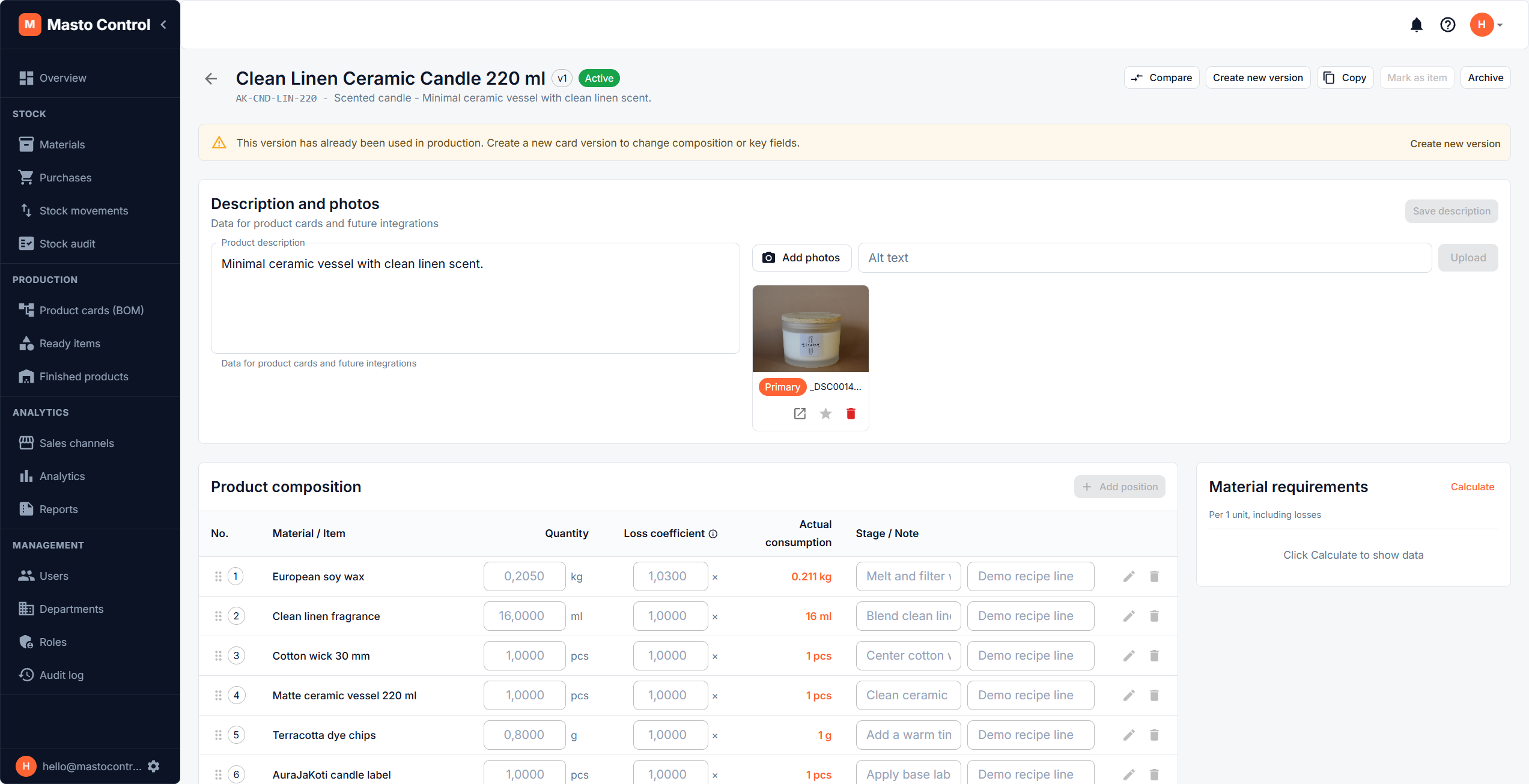
Masto, Stocksmith, Katana, inFlow and Zoho, with dated prices.
Free tool: every fee on one order, and what you keep.
Etsy's real cut, and the price that hits your margin.
Production runs, reservations and what happens to stock.
What a piece really costs, and what it earns per channel.
The formula, worked through on a 180 ml candle.
Free tool: cost per candle, Etsy fees, what to charge.
What happens to stock when an Etsy order lands.
Craftybase is now Stocksmith. How it compares, with dated sources.
Batches, expiry and oldest-first consumption.
Import your materials, write one recipe, see what it really costs. 14 days, full access, no card needed.
Get started →