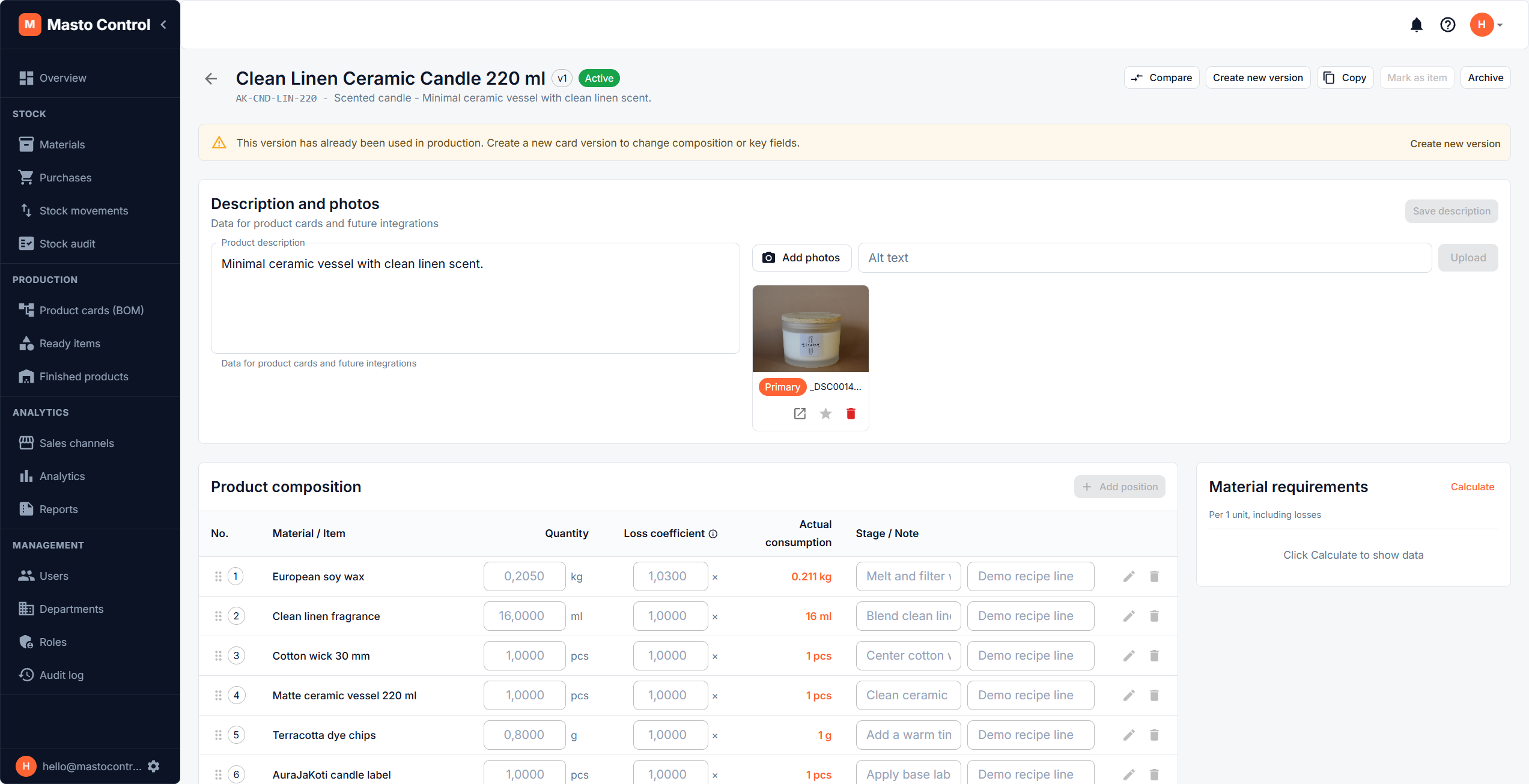
Enter what you bought and what you make. Masto Control works out materials, labour and packaging per unit, takes off the sales-channel commission, and shows your margin. It follows your supplier prices, so the number stays true.
Made for small manufacturers and makers who buy raw materials and produce in batches: candles, soap, cosmetics, jewellery, small-batch food.
| Materials (actual batches, oldest first) | €6.10 |
| Labour (10 min at €18/h) | €3.00 |
| Packaging | €1.40 |
| Cost of goods | €10.50 |
| Channel commission | €1.92 |
| You keep | €11.58 |
Buy wax at a new price and this updates by itself, for every product that uses it.
Pulled from the product's BOM and actual purchase prices - updates as supplier prices change.
Costed against what a production run actually consumed, not a static per-unit estimate.
Set a sale price and see the margin against the real cost - no more pricing on a hunch.
Costing is calculated automatically alongside your BOMs and production data - no separate spreadsheet to maintain.
Say you sell a 180 ml scented candle for €24 on a marketplace that takes 8%. Here is how the figure is put together, and why it moves on its own when your supplier prices move.
| Line | Where it comes from | Example |
|---|---|---|
| Materials | Wax, fragrance, wick and jar, each taken at the cost of the actual batch consumed, oldest first | €6.10 |
| Labour | 10 minutes of pouring, labelling and packing at the €18 hourly rate you set for that work | €3.00 |
| Packaging | Box, filler and label attached to this sales channel, deducted from stock on every sale | €1.40 |
| Cost of goods | Materials, labour and packaging | €10.50 |
| Channel commission | The percentage set on that sales channel, applied to the sale price. A selling cost, kept separate from the cost of making the item | €1.92 |
| What you keep | €24.00 sale price, less both of the above | €11.58 |
Labour is worked out for you: an hourly rate per role or operation, minutes on the card, and the cost follows through into every price and margin. What the software will not do is time you - there is no stopwatch and no per-worker time log, so the minutes are your estimate of the work. Workshop overhead is the same kind of judgement call: a fixed amount per unit, or a percentage of cost or of the sale price, that you decide. Materials and packaging are the parts that drift silently with every delivery, and those are counted from what you actually paid.
You bought wax at one price in spring and another in autumn. A spreadsheet keeps whichever number you typed in first. Costing from the batch actually consumed means the figure follows reality.
A little more fragrance, a different jar, an extra label. Each change is small, and none of them get back into the pricing sheet. Costing that sits on the recipe itself cannot fall behind it.
The same product sold on a marketplace, through your own shop and at a fair carries different packaging and different commission. One average price hides which of those actually pays.
The long version, with the arithmetic spelled out, is in our guide on how to calculate the true cost of a product. Costs are only as good as the stock data behind them, which is where inventory tracking comes in.
From the product's bill of materials (BOM) and the actual purchase cost of each material, including batch-level FIFO cost where relevant - not a manually estimated figure.
Yes - as supplier prices change, the cost calculation updates with them, so your margin figures reflect what materials actually cost you now.
Yes - set a sale price per product and Masto Control shows you the margin against its real calculated cost.
Yes - 14 days, full access, no credit card required.
Yes. Set what an hour of a role or an operation costs, then put the minutes it takes on the product card - the two are multiplied out for you and carried into unit cost, channel margins and the reports, next to materials and packaging counted from what you actually paid. Overhead goes in as your own expense types, a fixed amount per unit or a percentage of cost or of the sale price. What the software will not do is time you: there is no stopwatch and no per-worker time log, so the minutes are your estimate of the work.
Each purchase forms its own batch at its own price, and production consumes the oldest batch first (FIFO). The cost of a run reflects the batches it actually used, rather than a blended average that hides which was which.
Yes. If you make a base or a component in-house and then use it in a finished product, its own calculated cost carries through into the parent product rather than needing to be re-entered by hand.
Yes. Packaging can be set per channel, since a marketplace order and a market stall need different boxing, and each channel carries its own commission percentage. The same product can therefore show a different margin depending on where it sold.
Masto, Stocksmith, Katana, inFlow and Zoho, with dated prices.
Track raw materials and stock levels in real time.
Production orders, BOMs and cost control for small runs.
Candles, soap, cosmetics, food, jewellery: the same tool in their language.
The complete list of what the BOM & recipes module does.
Craftybase is now Stocksmith. How it compares, with dated sources.
Free tool: cost per unit, platform fees, what to charge.
Orders in, materials off stock, commission in the margin.
No credit card required. Full access from day one.
Start free trial →