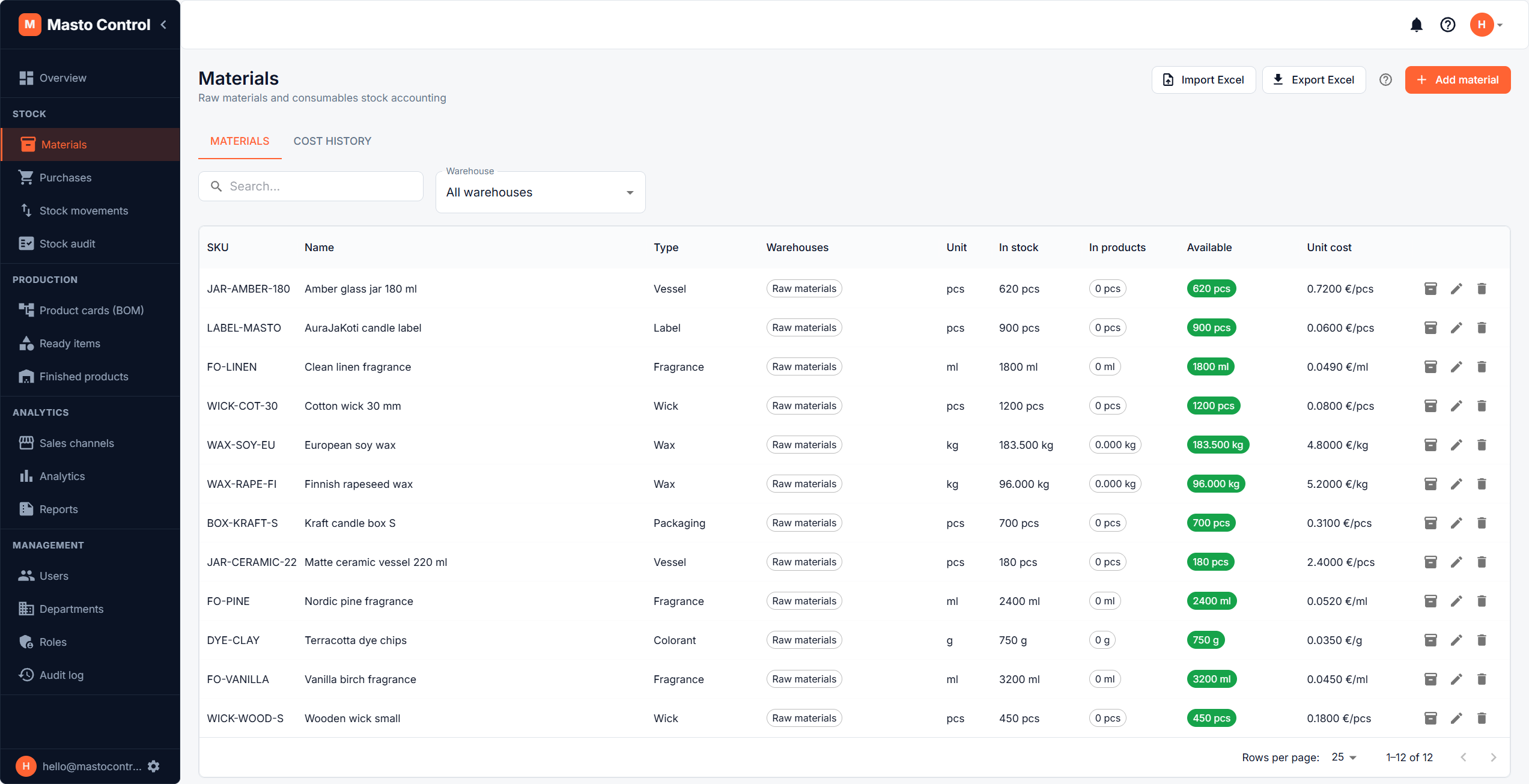
Spreadsheets drift out of date the moment two people edit them at once. Masto Control keeps raw material quantities live - updated automatically on every intake, write-off and production run - so what you see is what you actually have.
Someone forgets to update a cell, and suddenly the spreadsheet says you have stock you already used.
Emailed copies, shared drives, local edits - everyone ends up trusting a different file.
You find out a material is gone when production stops, not before.
Everything below is included on every plan - no add-ons, no per-material limits.
In a spreadsheet, a number just changes. You cannot tell who changed it, when, or why. Masto Control records every movement as its own entry, so a wrong figure is something you can investigate instead of argue about.
| Movement | When it happens |
|---|---|
| Purchase | You receive material from a supplier. Creates the batch its cost is later drawn from. |
| Reservation | A planned production run sets material aside, so it stops showing as available to anything else. |
| Consumption | A run is completed and the material is written off at its real batch cost, oldest batch first. |
| Rework return | A finished item is taken apart and its material goes back into stock. |
| Sale return | A sale is cancelled and you choose whether the goods return to stock. |
| Transfer | Material moves between two of your warehouses. |
| Audit | Someone corrects a count by hand after a physical stocktake. Recorded as a correction, not hidden. |
This is also what makes the cost figures trustworthy: the price a product costs to make comes from these recorded batches, not from a number someone typed in months ago. See how product costing works →
Masto Control is deliberately not a warehouse system for a distribution centre. It is sized for workshops where the same person often buys the materials, makes the product and ships it.
Wax, fragrance oils and wicks measured in grams and millilitres, bought in bulk and used across dozens of recipes. Unit handling and batch costing matter more here than pallet locations.
Ingredients with expiry dates that must not be used past them, and formulations where a small change in one raw material changes the cost of everything it goes into.
Short shelf lives, batch numbers you may need to trace back, and packaging that is itself a material you can run out of.
Many small components per finished piece, where the cost is spread across parts too fiddly to track by hand once you pass a few dozen products.
Sheet material and fittings measured in metres and pieces, with production runs that reserve stock before the work actually starts.
If your file has more than one tab, more than one editor, or a formula nobody dares touch, that is usually the point at which this pays for itself.
New to this? Start with our guide on how to track raw materials in a small manufacturing business.
Yes - quantities update automatically every time you record an intake, a write-off, or a production run, so there's no manual recalculation and no version-control mess.
Yes - each material can be tracked by batch number, purchase date and expiry, with FIFO cost calculation handled automatically.
No. The 14-day free trial gives full access with no credit card required.
Yes - you can import your current material list from Excel in one go instead of entering everything by hand.
Both. Materials can be measured in grams, kilograms, millilitres, litres, millimetres, centimetres, metres or pieces, so a recipe using 12.5 g of one thing and 3 pieces of another works without rounding tricks.
Scope. Traditional ERP assumes a purchasing department, a warehouse team and a long implementation. Masto Control covers materials, recipes, production and stock for a workshop where one or two people do all of it, and you can be running the same day.
No. Import or enter the materials you care about most, and correct the rest as you go - manual corrections are recorded as audit movements, so an approximate starting figure does not quietly corrupt your cost history.
Yes. Each person gets their own login and a role that decides what they can see and change, so a maker, a stockkeeper and an accountant are not all editing the same file.
Yes. For every product, Masto Control works out how many units your current materials allow, taking into account what is already reserved for other production runs.
Masto, Stocksmith, Katana, inFlow and Zoho, with dated prices.
Craftybase is now Stocksmith. How it compares, with dated sources.
Production orders, BOMs and cost control for small runs.
Know the real cost and margin of every product you make.
Candles, soap, cosmetics, food, jewellery: the same tool in their language.
The complete list of what the Inventory module does.
No credit card required. Full access from day one.
Start free trial →