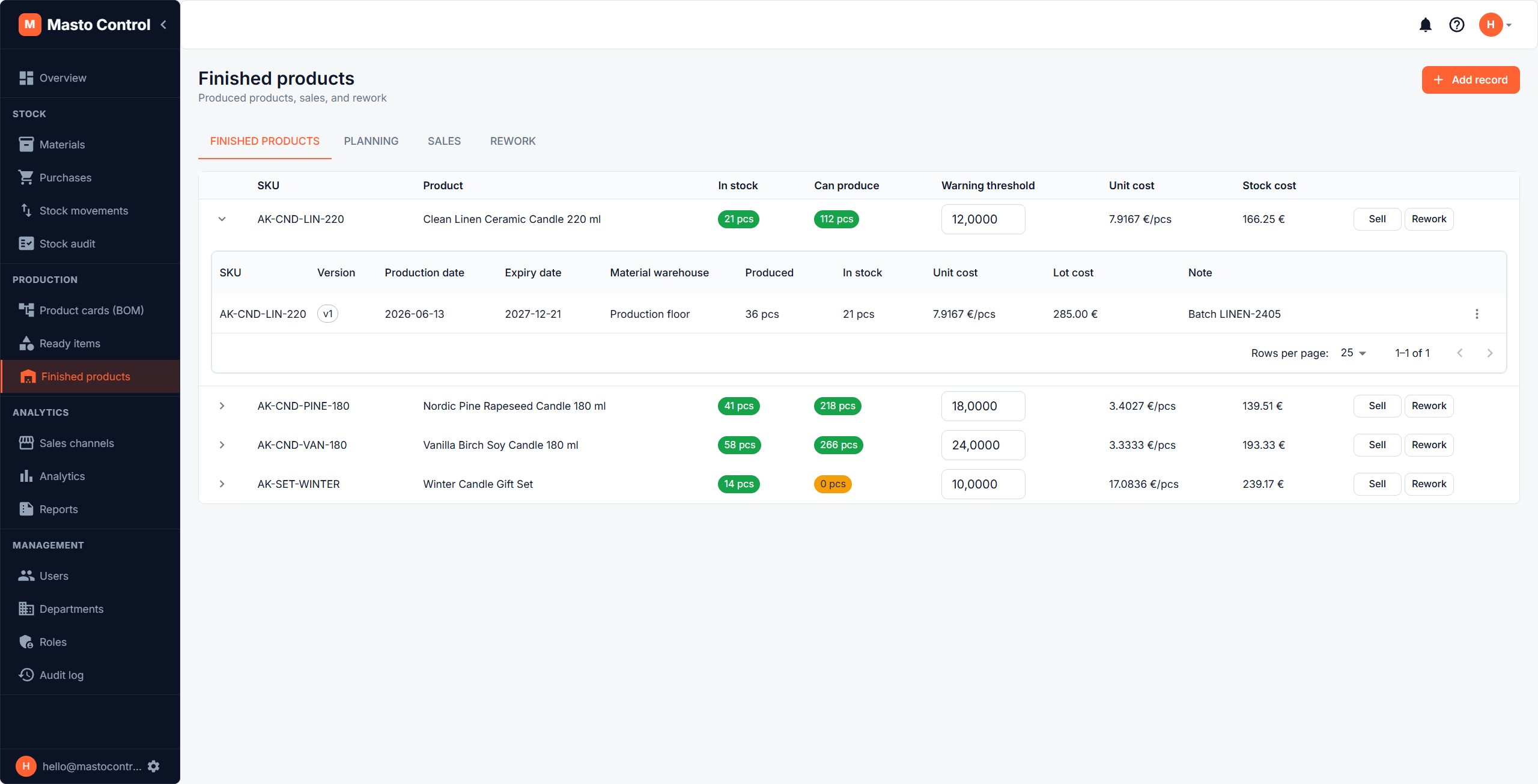
Start a production order, and Masto Control writes off the exact materials your recipe calls for, tracks the finished goods, and tells you what the batch really cost - no separate spreadsheet to keep in sync.
Plan a batch, start it, complete it - the system tracks what's in progress and what's done.
Define exactly what a product is made of, in what quantities - Masto Control uses it to write off materials automatically.
Every completed batch adds finished-product stock and a real cost figure - not a rough estimate.
Sized for a workshop running dozens or hundreds of units at a time - not a factory floor.
A batch is not one event, it is a few steps spread over days. Each one moves your stock, and that is exactly where hand-kept numbers start to drift.
Before committing, you see how many units your current materials allow, with anything already reserved for other runs excluded. No discovering halfway through that the fragrance is gone.
Creating the run sets its materials aside. They stop counting as available elsewhere, so two planned batches cannot silently promise themselves the same kilogram of wax.
On completion the materials are consumed at the cost of the batches actually taken, oldest first, and the finished units appear in stock as their own lot carrying that production cost.
Selling a lot deducts it along with its packaging. If a batch has to be reworked, the materials go back into stock instead of vanishing into a rounding error.
Every one of those steps is recorded as its own stock movement, which is how the inventory stays honest and how the cost per unit is worked out.
Regular runs of the same products, sold gradually across a shop, a marketplace and the occasional wholesale order. The question is always how much to make next.
Batches triggered by an order that just came in, where knowing immediately whether you have the materials decides what you promise the customer.
One or two people buying, making, packing and invoicing. Anything requiring a dedicated planner to operate is not going to survive contact with a real week.
Not sure where to start? Our guide on tracking raw materials covers the groundwork a first production run depends on.
Yes - Masto Control is built for workshops and small manufacturers running small batches, not factory-floor manufacturing execution systems with machine integrations.
Yes - when you start and complete a production order, the materials used are deducted from inventory automatically based on the product's BOM.
Yes - Masto Control calculates the real cost of each production run from the materials actually consumed, not just an estimate.
Yes - 14 days, full access, no credit card required.
You can rework it. The finished units come back out of stock and their materials are returned, recorded as their own movement, so the loss is visible rather than being quietly absorbed into the next batch's numbers.
No. Planning a run reserves its materials, and reserved stock stops counting as available. That is the difference between "we have 5 kg" and "we have 5 kg that nothing else is already spoken for".
Yes. Each completed run produces its own lot with the cost it was actually made at, so two batches of the same product made months apart do not get averaged into one indistinguishable pile.
Not in the traditional sense. There is no capacity scheduling, machine routing or shop-floor terminal. It covers recipes, material availability, production runs and what they cost - the parts a small workshop actually needs.
Masto, Stocksmith, Katana, inFlow and Zoho, with dated prices.
Craftybase is now Stocksmith. How it compares, with dated sources.
Track raw materials and stock levels in real time.
Know the real cost and margin of every product you make.
Candles, soap, cosmetics, food, jewellery: the same tool in their language.
The complete list of what the Production module does.
No credit card required. Full access from day one.
Start free trial →